Every Bangladeshi bears burden of $646 foreign debt: WB
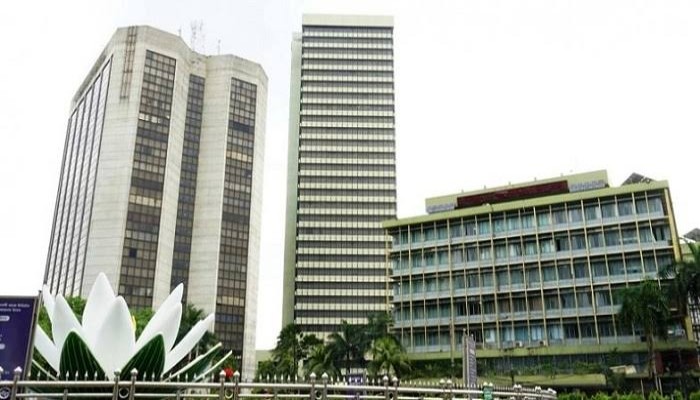
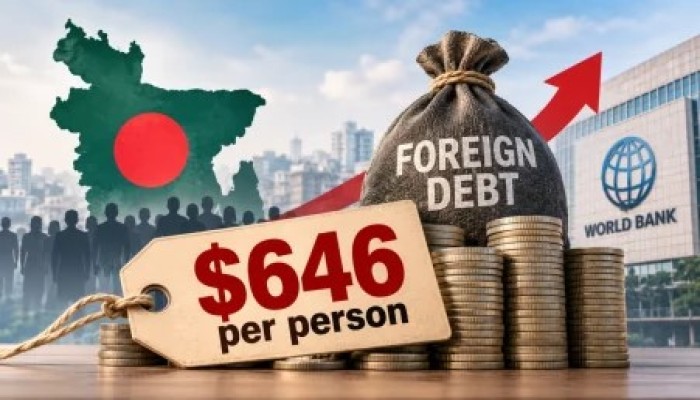
 AI Generated Symbolic Image (Collected)
The per-capita figure is calculated by dividing the country's total external debt by its population of 175.7 million, as reported by the World Bank, representing an average macroeconomic share rather than an individual citizen's personal liability.
Bangladesh's external debt reached $113.44 billion at the end of 2025, equivalent to approximately $646 per person in the country, as the outstanding debt stock increased 8.6% from a year earlier, according to the World Bank.
Released on November 5, the International Debt Report 2026 shows that the country's external liabilities have nearly tripled over the past decade, climbing from $38.77 billion in 2015.
The per-capita figure is calculated by dividing the country's total external debt by its population of 175.7 million, as reported by the World Bank, representing an average macroeconomic share rather than an individual citizen's personal liability.
The country's total debt stock comprises $89.51 billion in public and publicly guaranteed debt, $9.87 billion in private nonguaranteed debt and $14.06 billion in short-term debt.
Public and publicly guaranteed debt accounted for the largest portion, with multilateral creditors holding $51.14 billion and bilateral creditors $32.65 billion.
Private creditors accounted for another $5.72 billion of this category.
Among multilateral lenders, the World Bank's International Development Association (IDA) accounted for $22.64 billion, followed by the Asian Development Bank (ADB) at $17.52 billion and other multilateral creditors at $10.99 billion.
Japan was the largest bilateral creditor, with $12.72 billion, followed by Russia at $9.02 billion and other bilateral lenders at $10.90 billion.
The report's debt indicators show that external debt stood at 210% of exports in 2025, up 6.7% from 2015, while the debt-to-GNI ratio rose 5.9% to 24%.
Debt service, however, declined relative to both exports and national income.
Debt service as a share of exports fell 3.1% to 16%, while debt service as a share of GNI dropped 3.8% to 2% over the same period.
Meanwhile, the latest Bangladesh Bank data show gross external debt stood at almost $115 billion as of June 2026.
Bangladesh's per-capita external debt above South Asian average
Bangladesh's external debt per capita was higher than the South Asian regional average of approximately $564 in 2025, calculated from the region's combined external debt of $955 billion and population of 1.692 billion.
The World Bank's regional data cover six countries: Bangladesh, Bhutan, India, Maldives, Nepal and Sri Lanka. Their combined external debt increased 6.4% from 2024.
The region's external debt was equivalent to 21% of its gross national income (GNI), while debt service accounted for 10% of exports.
Among these countries, Bangladesh's per-capita external debt was higher than India's, at approximately $522, and Nepal's $401.
However, the figure was considerably lower than Sri Lanka's approximately $2,645, Bhutan's $4,218, and the Maldives' nearly $8,957 per person.
India accounted for the largest share of regional external debt, with $763.52 billion, followed by Bangladesh at $113.44 billion and Sri Lanka at $57.66 billion.
Meanwhile, Pakistan, which the report places under the Middle East, North Africa, Afghanistan and Pakistan grouping, had an external debt stock of $135.11 billion, equivalent to approximately $529 per person based on its reported population of 255.2 million.
Afghanistan, also classified under the same regional grouping, had an external debt stock of $3.42 billion, up 2.2% from a year earlier. Its reported population was 43.8 million.
Developing countries' external debt hits record $9.4 trillion
Globally, external debt in low- and middle-income countries rose 5.5% to a record $9.4 trillion in 2025, the fastest annual increase since 2021, according to the World Bank.
These countries paid a combined $1.4 trillion in principal and interest during the year, marking a fifth consecutive annual increase in debt-service payments.
"The return of private lending to low- and middle-income countries is welcome, but these countries are borrowing more, paying more, and in many cases leaving less for long-term development," said Haishan Fu, World Bank Group Chief Statistician and Director of Development Data.
The debt burden grew even faster among countries eligible for concessional financing from the World Bank, where external debt rose 8.1% to $1.3 trillion

 AI Generated Symbolic Image (Collected)